Monday, March 11, 2013

Plains, Georgia

"America did not invent human rights. In a very real sense human rights invented America."

          - President Jimmy Carter


March 5, 2013

Driving in to this small Gerogia town is like driving into some forgotten past. Quiet, neat, nostalgic and reminiscent of earlier times, it is a welcoming place.

The site of Jimmy Carter's campaign, the local depot.

Carter defeated incumbent Gerald Ford by a narrow but conclusive margin. Carter and his family were the first to walk hand in hand down Pennsylvania Avenue after his inauguration at the Capitol.


Few U.S. Presidents have had such close ties with where they were born and raised. The rural southern culture of Plains, Georgia, that revolves around farming, church and school, had a large influence in molding the character and shaping the political policies of the 39th President.

The old Plains High School has been renovated as the Jimmy Carter National Historic Site. Over seven years the community of Plains partnered with the NPS to restore the school and adapt it for reuse. The building serves as the park museum/visitor center. There is a restored and furnished classroom and exhibits that explain political and business careers, education, family, religion and post presidency.

Former First Lady Rosalynn Carter, three years younger than her husband Jimmy, graduated from Plains High School in 1944 as class valedictorian receiving the highest grades in her class.

This is President Carter's Nobel Peace Prize located in the hallway of  the old high school. Imagine your former high school being renovated into a museum about you.


The auditorium showing a film about Carter's Presidency is often full with busloads of students and tourists coming to Plains.


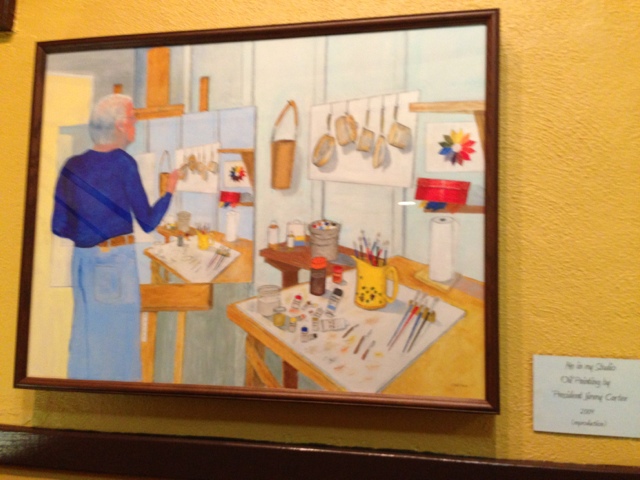
Jimmy Carter writes poetry and paints. This is an original hanging in the old high school hallway.

I drove out to Jimmy Carter's boyhood home and farm which was owned by Earl Carter, Jimmy's father, from 1928 until the late 1940's. Jimmy Carter lived here from the age of four until he departed for college. The farm is restored to its appearance before electricity was installed in 1938.


Rocking chairs on the front porch

Remember Miss Lillian, Jimmy's amazing mother who went into the Peace Corps? I liked to think of her living here.


The living room

The farm commissary (store) where neighbors would shop for goods


There were animals in the pasture.  It seemed that people from the 1930's could step out at any moment and go about the business of the farm.

I have wanted to come here for so long; I will always remember this special place.

Booker T. Washington

March 4, 2013

"Excellence is to do a common thing in an uncommon way." Booker T. Washington

In 1881, Booker T. Washington founded the Tuskegee Normal Scool for Colored Teachers on a former plantation with the mission of educating freedmen for self-sufficiency.

Today the university is a center of excellence for African-American education. One of the most famous teachers at Tuskegee was George Washington Carver, whose name is synonymous with innovative research into Southern farming and products.

Rosa Parks was born here.


The Oaks was Booker T. Washington's command center and Tuskegee Institute's social center. It was a place of employment and an on-the-job training site for students. The site is run by the National Parks Service.


Inside The Oaks: Faculty members often called on Sunday afternoons but Washington often "cloistered himself in his office Sunday afternoons while his wife Margaret was entertaining young faculty members in the parlor."


The family moved into the house in 1900. The Queen Anne style red brick house, with steam heating and electrivity, was the first of its kind in Macon County. Most furnishings were made by local craftsmen and students and acquired between 1885-1889. Prominent people visited The Oaks including Andrew Carnegie and President Theodore Roosevelt.


A teacher's school was the dream of Lewis Adams, a former slave. Despite lacking formal education, Adams could read, write and speak several languages. He was an experienced tinsmith, harness-maker and shoemaker, an acknowledged leader of the African-American community in Macon County, Alabama. His daughter was the first graduate of the Tuskegee Normal School.

Booker T. Washington's office as he knew it.


In The Oaks gift shop.


The home set an example for what students could accomplish.


A few miles away is the flight field where the first African-American military aviators in the United States trained during World War II. The Airmen were subjected to racial discrimination. In spite of this they trained and flew with distinction. 992 pilots were trained in Tuskegee from 1941 to 1946.


Contrary to negative predictions from some quarters, Tuskegee Airmen were some of the best pilots in the U. S. Army Air Corps. Nevertheless, the Tuskegee Airmen continued to have to fight racism.
After segregation in the military was ended in 1948 by President Truman, the veteran Tuskegee Airmen found themselves in high demand throughout the US Air Force.

The National Park Service created a stellar exhibit.


Scott & Zelda in Montgomery

October 8, 1931 the Montgomery newspaper announced with a headline: Scott Fitzgeralds to Spend Winter Here Writing Books. There was excitement at the return home of the former Zelda Sayre, daughter of a prominent judge, after the Jazz Age couple's extended tour of Europe.

The paper kindly overlooked Zelda's discharge from a Swiss clinic one month earlier following prolonged treatment for her first "breakdown."

The famous couple leased a home at 919 Felder near Zelda's parents. By November, Scott had accepted a job in Hollywood and left Zelda with their ten year old daughter, Scottie, in the Felder house.

An excerpt from one of my favorites: The Great Gatsby

"We walked . . . Into a bright rosy-coloured space, fragilely bound into the house by French windows at either end. The windows were ajar and gleaming white against the fresh cut grass outside that seemed to grow a little way into the house. A breeze blew through the room, blew curtains in at one end and out the other like pale flags, twisting them up toward the frosted wedding-cake of the ceiling, and then rippled over the wine-coloured rug, making a shadow on it as wind does on the sea."

- The Great Gatsby, F. Scott Fitzgerald


While they occupied the house on Felder, Zelda's feelings for Scott remained true and she wrote to her husband, "Scottie is so sweet and darling and the house is so pleasant and I have everything in the world except you."


The home is now the Fitzgerald Museum, however it was closed when I was there.


A map! in case you were wondering where Montgomery is.


The North would not let us govern ourselves.

March 2, 2013

Side by side in Montgomery with Civil Rights History is Civil War History.

This is a statue of Jefferson Davis, first and only President of the Confederate States inaugurated 1861 on the front steps of the Georgia Capitol.


This star marks the place where he was inaugurated. Look for it in the next photo.


(clue - look in the sw corner)


This cornerstone is part of the monument to the Confederacy next to the Capitol.

Monument to the Confederacy

Jefferson Davis' "White House", across the street from the Capitol, open to the public and free of charge.

In historian Wm. Cooper's biography of Jefferson Davis in 2000 he writes, "His preoccupation with detail, reluctance to delegate responsibility, lack of popular appeal, feuds with powerful state governors, inability to get along with people who disagreed with him, and neglect of civil matters in favor of military ones all worked against him."


More photos inside the house.


"To me, history ought to be a source of pleasure. It isn't just part of our civic responsibility. To me, it's an enlargement of the experience of being alive, just the way literature or art or music is."

- Historian and author David McCullough

I Have a Dream

March 2, 2013

Montgomery, Alabama is one of the main places of the Civil Rights Movement of the l960's

This is Dexter church from which Martin Luther King, Jr. led the 1955 Montgomery Bus Boycott.
I was fortunate to be allowed inside between tours and shown around by volunteers who attend church there.


Martin Luther King, born 1929 in Atlanta, GA and was killed 1968 in Memphis Tennessee. He received the Nobel Peace Prize in 1964 for his role in the advancement of civil rights using nonviolent civil disobedience.


I parked at the Visitors Center down by the river, rode the trolley up to the Capitol, then walked back using this map to see the sites.


Riding the trolley downtown Montgomery.


The view is from the front steps of the Capitol of Georgia. Dexter Baptist Church is the red building on the left.

Bloody Sunday refers to March 7, 1965 when the Atlanta State Troopers beat up the Civil Rights workers attempting to march to Montgomery from nearby Selma, AL. Footage of police brutality against the protesters was broadcast extensively and aroused national public outrage.

King led 6,000 marchers out of Selma on March 25, 1965 with Federal protection. After 4 days, over 20,000 marchers walked up this street to the Capitol where Governor Wallace hid out inside while MLK gave a speech stating that equal rights for African Americans could not be far away, "because the arc of the moral universe is long, but it bends toward justice."


This marks the spot where Rosa Parks boarded the bus igniting the Civil Rights Movement.


Inside the Dexter Church I heard excerpts from King's famous speeches.


Near the Dexter Church is the Southern Poverty Law Center and this Civil Rights Memorial that honors the achievements and memory of those who died during the Civil Rights Movement, a period framed by the Brown v. Board decision in 1954 and the assassination of Dr. Martin Luther King in 1968. The memorial serves as education and reflection about the struggle for equality.

The Memorial was created by Vietnam Veterans Memorial designer Maya Lin.


These markers are along the highway between Montgomery and Selma. Also there are signs to show where all the marchers camped along the way.


In 1996 the Selma to Montgomery National Historic Trail was created by Congress.

Your Cheatin' Heart

March 1, 2013
                            Gracious Southern artificial flowers grace the Walmart restroom in Monroeville


On the way to Montgomery, I stopped in Georgiana, Alabama,to have a look at where Hank Williams spent his childhood.
Some of his songs you may have heard, "Cold Cold Heart","Hey, Good Lookin'", "I'm So Lonesome I Could Cry", and the familiar "Your Cheatin' Heart".

The lady who took the $3 at the door told me lots about Hank and his tough young life.


  (T@B is always trying to get into the picture!)


Born in 1923, died at 29 in 1953, he was the Elvis of his day.


Hank recorded 35 singles that would place in the Top 10 of the Billboard County & Western Best Sellers chart including 11 that ranked number one. He always credited his musical learning to Rufus "Tee-Tot" Payne, a black street performer from Georgiana who gave him guitar lessons in exchange for meals or money.

In 1944 he married Audrey Sheppard, declared illegal since Sheppard's divorce from her previous husband did not comply with the law, and the marriage went downhill from there.


He accomplished a lot in his 29 years.


His son, Hank Jr., erected this grave marker in Montgomery, Alabama


The grave is in a huge cemetery but there is a special road sign to direct those of us fans who come to pay our respects.

To Kill a Mockingbird

February 28, 2013

This is the Monroeville, Mississippi Courthouse made famous by the novel To Kill a Mockingbird. The plot, involving racial injustice and loss of innocence, and the characters are loosely based on the author's observations of her own family and neighbors; her father was a highly respected lawyer in the town.

Here is a little of the text from the book. The narrator is Scout, nickname for the twelve- year old daughter of Atticus Finch. Here she is describing her brother, Jem.

"The sixth grade seemed to please him from the beginning: he went through a brief Egyptian Period that baffled me - he tried to walk flat a great deal, sticking one arm in front of him and one in back of him, putting one foot behind the other. He declared Egyptians walked that way; I said if they did I didn't see how they got anything done, but Jem said they accomplished more than the Americans ever did, they invented toilet paper and perpetual embalming, and asked where would we be today if they hadn't? Atticus told me to delete the adjectives and I'd have the facts."

-Harper Lee, To Kill a Mockingbird


I was surprised at how emotional it felt to be in the Courtroom which is the model for the one seen in the 1962 film with Gregory Peck as Atticus Finch.


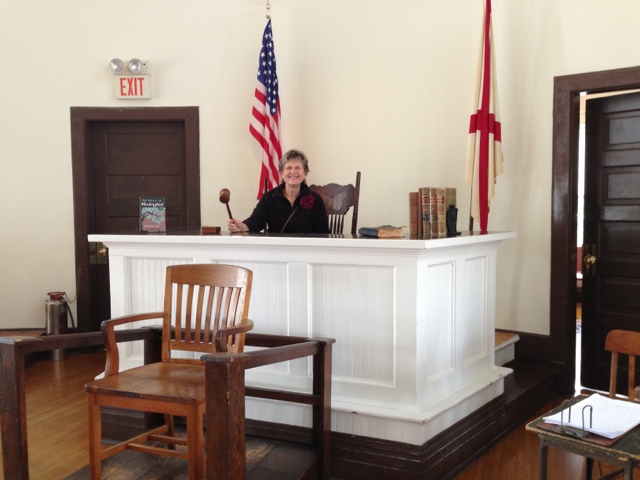
Sitting in the Judge's place; that's the spot for me.


Upstairs is an exhibit on another famous author from Monroeville, Truman Capote. He and Harper Lee were neighbors. As children they had a little pretend office where they would spend a little time every day typing on an old typewriter.


In the gift shop I enjoyed this artist's rendering of famous Mississippi authors: Helen Keller, Booker T. Washington, Martin Luther King, Jr., Truman Capote and Harper Lee.


All that is left is the wall between the homes of the two authors.

I have always enjoyed A Christmas Memory by Capote. Here is an excerpt:

"It's always the same: a morning arrives in November, and my friend, as though officially inaugurating the Christmas time of year that exhilarates her imagination and fuels the blaze of her heart, announces: "It's fruitcake weather! Fetch our buggy. Help me find my hat."

The hat is found, a straw cartwheel corsaged with velvet roses out-of-doors has faded: it once belonged to a more fashionable relative. Together, we guide our buggy, a dilapidated baby carriage, out to the garden and into a grove of pecan trees."

- Truman Capote, A Christmas Memory